Our Vision
Assumption Church is committed to making disciples by serving and loving our surrounding community in a way that bears witness to the love and presence of Jesus.
Our Mission
Love God. Serve Others. Grow Disciples.
You Matter + You Belong
Our Strategy
We aim to be a church that people who don’t like church, like! Our strategy is to creatively reach out to disconnected Catholics in our Centereach-Lake Grove communities with a fresh and relevant presentation of the life-changing message of the Gospel to help them take their next steps on the path of discipleship to make them fully devoted followers of Jesus Christ.
Our Focus
Our weekend experience is central to our strategy and the weekend message is central to the weekend experience. Music, message and ministers work together to create an irresistible environment of energy and excellence in which newcomers feel welcome and want to come back.
Worship
We believe in Orthodox Christianity, as taught by the Roman Catholic Church. The Eucharistic celebration is the source and summit of our faith, which we seek to live and serve with the whole of our lives in vibrant and creative ways. Excellence in our worship honors God.
Fellowship
We believe that our Baptism makes us one family in which we learn to love one another as Christ loved us. We strive to build a church culture through Small Groups where people are open and authentic, especially about their need to grow and change. We want to build a stronger community through fellowship after the weekend celebrations.
Discipleship
We believe the Bible is the inspired, infallible Word of God. Our preaching and messages aim to break open the relevance of the Bible for our daily lives Discipleship ultimately means life-change.
Service
We believe that the Holy Spirit has prepared works for us to do that will advance the kingdom of Christ. We recognize God’s call on our church to serve both within our parish and beyond.
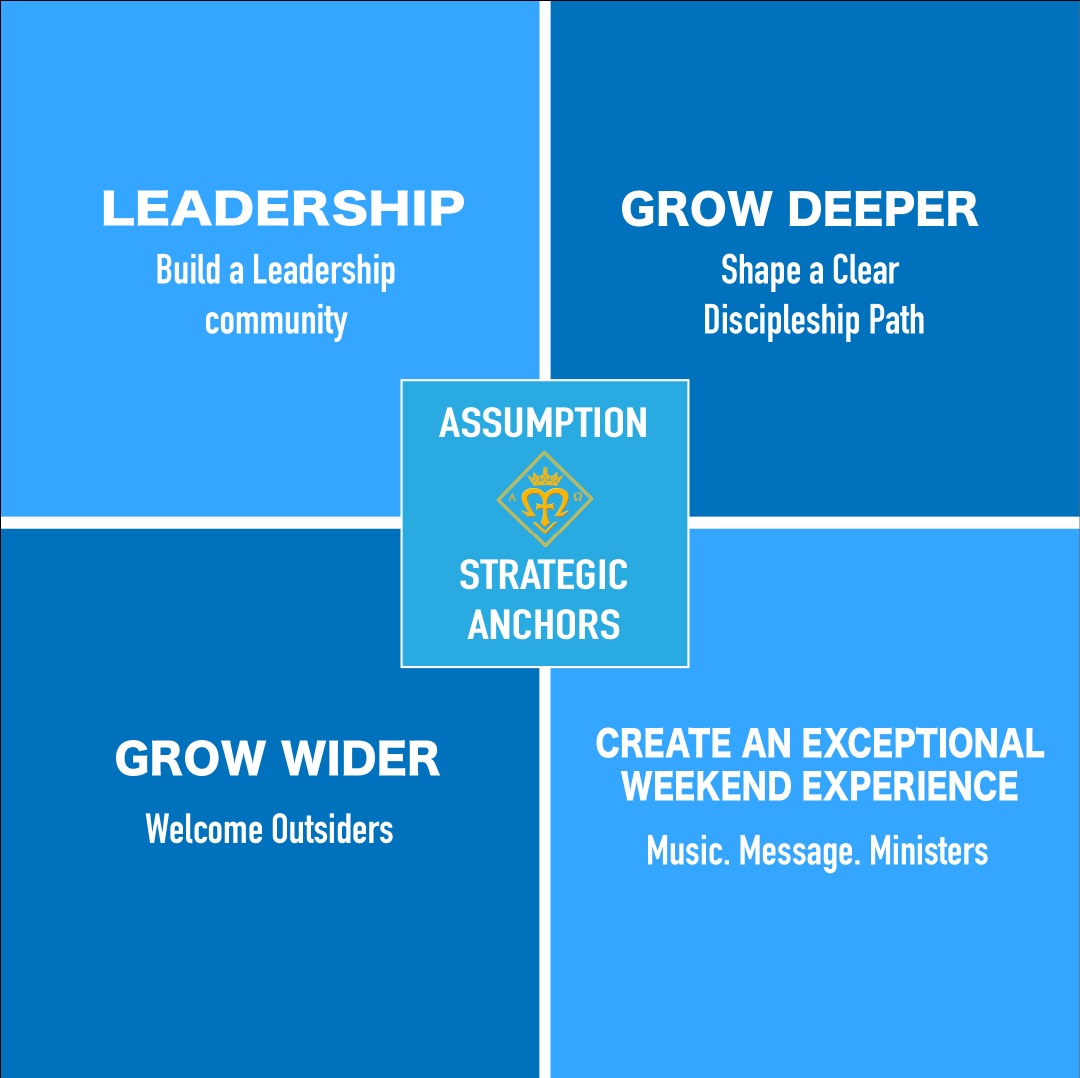 |
Weekend Experience Making the weekend experience, music, messages, ministers, a top priority to keep parishioners connected and attract the unchurched. Leadership Building layers of leadership because everything rises or falls on leadership. Grow Deeper Preaching and teaching a clear discipleship path so that parishioners can grow as Christ followers. Grow Wider Keeping evangelization front and center of everything we do, because who we’re reaching is more important than who we’re keeping. |
Do You Remember?
Years ago, people spoke of Suffolk County on New York’s Long Island as “the country.” They knew there were beaches on the north and south shores to visit in the summer, but not much in between, save for farms and occasionally sleepy towns. With the end of World War II, however, the face of the county began to change. New houses sprang up. New businesses started. New communities were developed. Old communities expanded. The reason was an influx of new people, usually hard-working people who found a way to exchange the noise, dirt, and confusion of the city for the peace and beauty of “the Island.”
But any growing community, new or old, has needs, and perhaps the most important are spiritual. So, it was with Centereach. By the early 1950s, the number of Catholic families had grown to nearly a thousand and was still increasing. These families were welcomed at St. Joseph’s Church in Ronkonkoma and St. Margaret of Scotland Church in Selden. Naturally enough, the people in the area wanted their own parish, their own house of worship. And so, on September 2, 1953, Mrs. William Groben, an area resident, wrote to Archbishop Thomas E. Molloy of the Brooklyn diocese, advising him of the needs of the Catholic faithful of Centereach.
Fr. Fitzgerald Comes to Centereach
Although he did not act immediately upon Mrs. Groben’s letter, Archbishop Molloy realized that something had to be done. In 1955, he sent Rev. Francis A. Fitzgerald to Centereach as its first pastor. In July, Fr. Fitzgerald, arriving with only $400 to start the new parish, rented a small summer bungalow on Wood Road. He offered his first Sunday Mass in Centereach on July 10, 1955. His temporary church was the local Veterans of Foreign Wars (VFW) hall, a Quonset hut on Middle Country Road, where Sunday Masses were offered until the present church was completed in 1958.
A week later, Fr. Fitzgerald celebrated the first baptism in the new parish, that of Patrick Joseph Hayes. (In those early days, parish baptisms and marriages were performed in St. Joseph’s Church in Ronkonkoma.)The first parish marriage occurred three years later, on May 4, 1958, when John Vogel of Centereach wed Charlotte Keene of Infant Jesus Parish in Port Jefferson.
A rented bungalow and a Quonset hut were humble beginnings for the new parish. But there was ample promise for the future in the energy of Fr. Fitzgerald and the dedication of the parishioners, led by the first trustees, Philip Schmitt, John F. O’Neill, and Ernest Camerlingo. Indeed, the parish—with about a thousand families—was already sizable, so Fr. Fitzgerald moved quickly to find a site for a church. Shortly after arriving, he purchased property on Crown Acres Road, just off Middle Country Road. There was a development house near the property that he remodeled into a rectory. A small chapel built into the new rectory served as a place where the pastor could offer daily Masses.
As 1955 drew to a close, the Catholic families of Centereach had begun to see a dream come true: a parish of their very own. Fr. Fitzgerald named it Assumption of the Blessed Virgin Mary–the name of his parish in his homeland, Ireland. But the name was appropriate for another reason, too, for near the beginning of the decade—on November 1, 1950—Pope Pius XII declared the Assumption a doctrine of faith, thus crowning centuries of belief in this mystery.
Erecting a Church—the Original Vision
As 1956 began—the first full year of the parish’s existence—one excellent task lay ahead: erecting a church building on the Crown Acres Road property. In that same year, Rev. Joseph A. Belfiore arrived to assist Fr. Fitzgerald with this and other tasks. On August 1st, the initial building campaign for the new church started. At that time, the architectural firm responsible for designing the structure released details of what it would look like: a building with a warm brick exterior and pitched roof with overhanging eaves ventilated by awning-type wood windows; an interior that was devotional and spacious, with single-span, laminated wooden arches supporting the nave roof; interior walls of colored masonry, a colorful vinyl tile floor, and a choir loft spacious enough to accommodate a complete parish choir. Flanked by carved wood side altars of the Blessed Mother and St. Joseph, the sanctuary would feature a wood-paneled design to accentuate a beautiful marble high altar. (A lovely painting of the Assumption was placed above this altar later. For a photo of that painting, as well as pictures of various phases in the construction, click here.)A life-size wooden crucifix was to be mounted on the rear wall.
This, at least, was what the parish hoped the new church would look like. Whether and how soon that hope would come to fruition depended on the success of the fundraising drive begun on August 1, 1956. The initial goal was $50,000. Within two weeks, a concerted effort produced $88,792, and funds continued to pour in. On May 19, 1957, before a large crowd of parishioners and well-wishers, a group of altar boys formed a procession at the parish house and marched to the site where the church would be built. There, Fr. Fitzgerald, with Fr. Belfiore at his side, lifted a hefty shovelful of earth to signify ground-breaking for the beautiful church that would rise on that spot.
A Mortgage Is Burned
A little over a month before, on April 6, 1957, the parish became part of a new diocese—the Diocese of Rockville Centre, which Pope Pius XII created by separating the parishes of Nassau and Suffolk Counties from the Diocese of Brooklyn. He named the Most Reverend Walter P. Kellenberg as Bishop of Rockville Centre. It is easy to imagine the joy of the parish when the new church, completed the following year, was dedicated on September 27, 1958, by Bishop Kellenberg. For many parishioners, that joy was doubled as the first Confirmation class of two hundred children received the sacrament of the Holy Spirit.
Erecting the church left the parish with a considerable debt, the kind that often takes many years to pay off. Yet the parish members took only seven years to do it. The festive, mortgage-burning ceremony took place on December 6, 1963. Fr. Belfiore held the document while Philip Schmitt, general chairman of the building fund campaign, struck the match that set it aflame, as the officers of the societies and a delighted audience of parishioners looked on. It was a joyous occasion, with but one somber note: Fr. Fitzgerald was not there to witness it. The previous August, he died while visiting his native Ireland. Undoubtedly, he went to his reward knowing that the debt would soon be liquidated. More importantly, he lived to see the result of his dedication, leadership, and love of God—a beautiful new church that was the center of a vital, flourishing parish.
A New Pastor Comes to Centereach
Upon Fr. Fitzgerald’s death, Fr. Belfiore served as administrator of the parish until the Spring of 1964, when Bishop Kellenberg appointed Rev. Gerard J. Sheridan as pastor. Raised in Patchogue, Fr. Sheridan studied for the priesthood at Cathedral Seminary in Brooklyn. After his ordination in 1935, he served for a short time in Belle Harbor, and then spent five years at St. Theresa’s Church in Brooklyn, followed by twenty years of service in St. Aidan’s Parish in Williston Park. At that point, Fr. Sheridan turned from parish priest to professor when he went to Huntington Seminary to teach Spanish and pastoral theology.
Fr. Sheridan’s first assistant was Rev. John Serrano, from Barcelona, Spain. Over the years, Fr. Sheridan was fortunate to have had the assistance, not only of Fr. Serrano, but also of Rev. Rocco Gallitelli, Rev. Michael Hoban, Rev. Charles Staiger, Rev. John Gabriele, Rev. Charles Fink, Rev. Francis Sang, Rev. Francis Corrao, and Rev. Hector Valenzuela. (For a list of all priests assigned to Assumption of the BVM parish, click here.)
Vatican II
Vatican II brought many changes to Church life, none being more far-reaching than the active inclusion of lay members in parish planning and ministry. In August of 1967, Fr. Sheridan advised that parishes were to start parish councils, called for a parish census, and consulted with the heads of all parish societies on how best to proceed in this new direction. Under the guidelines provided by the diocese, Fr. Sheridan could have appointed people to the council, but he chose not to, instead wanting the members of the parish to set up the council themselves in a fully participatory manner. Working with a steering committee comprised of various parish leaders, the first parish council was established, represented by a diverse group of parishioners: a plumber, chiropractor, pharmacist, truck driver, banker, clerical workers, a doctor’s receptionist, and homemakers. This initiative was perhaps the first such council in the diocese chosen by a democratic election.
John O’Malley Associates of Brooklyn, who designed the Church, was chosen to design the Parish Center. Plans called for a two-story building containing ten classrooms, a kitchen, a library, meeting rooms, and an all-purpose room. Ed Quinn was the chairman of the fundraising campaign for furnishing the Center. By the Spring of 1971, the impressive new Center was ready. Dedicated on May 25, 1971, with a Mass concelebrated by Fr. Sheridan and Bishop Kellenberg, two hundred fifty children received the Sacrament of Confirmation at the same celebration.
In 1975, the present rectory was opened, providing more space for the five priests living there. The parish continued to grow, with an increasing number of baptisms, communions, confirmations, and weddings, reflecting the parish's general youthfulness, which by then numbered about 3,800 families. For a time, bingo (discontinued in 1994) was the parish’s primary fundraiser, as was true in parishes throughout the diocese. High school religion continued to thrive – a great success for its day. In 1983, Fr. Sheridan retired, but remained somewhat active in the parish until his death in September 1986. (For a list of all priests assigned to Assumption of the BVM parish, click here.)
In June 1983, the bishop assigned Rev. Joseph K. Curley as the third pastor for the parish. A former high school teacher, he continued a strong adult education program, emphasizing the teaching of the Bible and the principles of Vatican II. In addition, Fr. Curley fostered our children's education, working with Miriam Selig, who coordinated the parish’s elementary Religious Formation program from 1973 until her retirement in 2003. Admittedly not a singer of note, he provided for parish liturgical experiences by supporting our parish music ministers, Barbara Wandling, Diane Sherman, and Joan Barrett. In addition, his vision and guidance transformed an already strong high school instructional program into a Youth Ministry program under the leadership of Janet Arato for almost twenty-five years. During this time, additional parish organizations and programs emerged that greatly enhanced parish life: Respect Life and Outreach, both guided by Florence Talluto, became an essential part of the parish mission; Catholic War Veterans, the parish’s Baptism preparation program, RCIA, and in-home pre-Cana, to name a few. Sustained by his pastoral care and presence, existing groups continued to grow as they served parish needs, including the Boy Scouts, which won numerous "Best Troop in the Diocese" awards, the Rosary Altar Society, and the Catholic Daughters of America.
Within a few years of his pastorate. Fr. Curley realized that the Church needed a bit of a facelift. Therefore, starting in 1987, he initiated a multi-year beautification process that included improved lighting, the installation of richly paneled walls, new carpeting, the removal of altar rails to create more space and better access, and the addition of beautiful stained glass windows depicting various biblical scenes. (You can see these windows and a detailed explanation by clicking the link.) In 1996, this process was completed by placing a large cross behind the altar to “bookend” the large Resurrection window at the western end of the church, thus emphasizing the Paschal mystery — the death and resurrection of Jesus. This was also the year that Pope John Paul II honored Fr. Curley (and the parish) by conferring upon him the honorary title of Monsignor.
During this period (December 1988), the diocese adjusted our parish boundaries by creating several new parishes to the south of us. The 800 or so families involved were allowed to decide whether they wanted to be part of this new, parish-building venture. By the time the new churches were built, most of these families had become part of the new parishes. Without realizing it at the time, this helped the parish by eliminating the need to expand the church and the religious formation program, an endeavor the parish might not have been able to sustain in light of what lay ahead.
By the millennium, additional changes appeared on the horizon. Some had been predicted, some were unexpected. For example, Mass attendance and overall participation in parish life had been decreasing over the years, not just in the parish but throughout the diocese and the Church. A substantial decrease in clergy vocations further complicated the situation. In addition, in 2002, a tsunami beyond expectation pounded the Church as the priest's sex scandals became public. Although Assumption parish had been spared, the entire parish felt the pain and distress that came from the ongoing revelations. Some stopped participating in parish life to give voice to their anger at the bishops, the abusing priests, the inadequate response by the institutional Church, and the perceived cover-up and lack of accountability by Church leaders.
The convergence of these and other forces challenged Msgr. Curley and the parish to provide a prudent and pastoral response which would allow the parish to weather the storm of a clergy shortage, parishioner frustration and anger, and decreasing parish participation. In addition, the country’s economic climate had begun to change, with many parishioners losing their jobs or experiencing a sharp decrease in income. It would be up to the next pastor, Fr. Chris Aridas, to help the parish move forward with less.
(FYI–The following priests served with Msgr. Curley during his twenty-eight years as pastor: Rev. Raymond Nugent, Rev. Peter Liu, Rev. Warren Gress, Rev. Barry Mercado, Rev. Andrew Nirrengarten, Rev. Al Rogers, Rev. Vincent Martega, Rev. Raymond Joseph, Rev. Larry Duncklee, Rev. William Shean, Rev. Paul Myas, Rev. Augustine Kuriapilly, Rev. Charles Srion. When Msgr. Curley began in 1983, with four priests assigned to the parish. By the time of his retirement in 2011, there was only one.
Today and Tomorrow
In June 2011, Bishop William Murphy assigned Fr. Chris Aridas as the fourth pastor for Assumption of the Blessed Virgin Mary parish, replacing Msgr. Curley, who had reached the mandatory retirement age. An avid reader (exceeded only by Mgr. Curley!) and prolific author, Fr. Chris completed his doctoral studies at Fordham University while he headed the Diocesan Office of Charismatic Renewal (1982-1992). He brings eighteen years of experience pastoring a neighboring parish to Assumption Parish.
Upon arriving, Fr. Chris encountered several significant staff changes that had been planned well before his appointment: Florence Talluto, the long-time Business Manager and Outreach coordinator, and Janet Arato, the parish’s highly regarded Youth Minister, were both retiring, thereby substantially reducing the parish’s pastoral staff. In addition, Fr. Peter O’Rourke, who had been a resident for several years at the parish as he worked at SUNY Veterans Home, announced his plans to relocate to Hauppauge. In 2011, Fr. Charlie was assigned to another parish (he eventually retired in 2018), and Fr. Joseph Alenchery joined the parish team. Supported by the dedicated clergy assigned to the parish, a talented Religious Formation staff, and parish volunteers willing to serve as needed, Fr. Chris served as pastor until June 2019. During that time, the parish completed several significant projects, including the opening of the Msgr. Joseph K Curley Parish Center and the renovation of the church interior. In addition, under his guidance, the parish’s faith formation program was revised, inaugurating a successful “Take Back Sunday” initiative that included family catechesis. During this time, Msgr. Curley remained a resident until 2019. In February of 2019, an opening became available at the diocesan priest retirement home, St. Pius X, located in Amityville. Msgr. Decided to make the move after more than thirty-five years in the parish.
In June 2019, Fr. Chris Aridas retired, succeeded by Fr. Joseph Alenchery, who now shepherds the parish toward the task at hand. Fr. Chris stayed in the parish for the next two years after his retirement. However, in 2022, he passed on to his eternal reward.
2020 was a particularly challenging year due to the COVID-19 pandemic. Its effects devastated the parish's work and its liturgical celebrations. But it gave us an opportunity to rethink our approach to ministry and mission.
In 2021, the parish took a new direction with the Rebuilt Parish coaching program. We established our Rebuilt Team. That gave the parish a new life. Vision and mission statements were established.
Our Vision: Assumption Church is committed to growing disciples by serving and loving our surrounding community in a way that bears witness to the love and presence of Jesus.
Our Mission: Love God, Serve Others, Grow Disciples. You Matter! You Belong!
Our Mission is supported by various ministries, such as The Welcome Ministry and Hospitality, which includes Coffee in the Courtyard and later became the Vision Cafe after the 9:30 and 11:30 Masses on Sundays. These initiatives energize our community and foster unity. Additionally, Small Groups encourage participants to delve deeper into the weekly message, creating a sense of closeness among members and strengthening their connection with the parish.
In 2025, Assumption celebrated its 70th anniversary. It was a time of memories, community, and celebration.
| Rev. Francis A. Fitzgerald | 1955-1963 | Pastor, 1955-1963 |
| Rev. Joseph A. Belfiore | 1956-1964 | Fr. Fitzgerald |
| Rev. Gerard J. Sheridan | 1964-1983 | Pastor, 1964-1983 |
| Rev. John Serrano | 1965-1968 | Fr. Sheridan |
| Rev. Rocco Gallitelli | 1965-1974 | Fr. Sheridan |
| Rev. Michael Hoban | 1968-1971 | Fr. Sheridan |
| Rev. Charles Staiger | 1971-1975 | Fr. Sheridan |
| Rev. John Gabriele | 1974-1981 | Fr. Sheridan |
| Rev. Charles Fink | 1976-1983 | Fr. Sheridan |
| Rev. Santiago Dineros | 1978 | Fr. Sheridan |
| Rev. Francis Sang | 1978-1972 | Fr. Sheridan |
| Rev. Francis Corrao | 1979-1980 | Fr. Sheridan |
| Rev. Hector Valenzuela | 1980-1982 | Fr. Sheridan |
| Rev. Raymond Nugent | 1981-1985 | Fr. Sheridan & Msgr. Curley |
| Rev. Peter Liu | 1982-1987 | Fr. Sheridan & Msgr. Curley |
| Msgr. Joseph Curley | 1983-2010 | Pastor, 1983-2010 |
| Rev. Warren Gress | 1983-1988 | Msgr. Curley |
| Rev. Barry Mercado | 1985-1987 | Msgr. Curley |
| Rev. Al Rogers | 1987-1994 | Msgr. Curley |
| Rev. Vincent Martega | 1988-1991 | Msgr. Curley |
| Rev. Andrew Nirrengarten | 1988-1993 | Msgr. Curley |
| Rev. Raymond Joseph | 1990-1997 | Msgr. Curley |
| Rev. Larry Duncklee | 1993-1996 | Msgr. Curley |
| Rev. Paul Mijas | 1996-2001 | Msgr. Curley |
| Rev. William Shean | 1996-2004 | Msgr. Curley |
| Rev. Augustine Kuriapilly | 2001-2002 | Msgr. Curley |
| Rev. Charles Srion | 2002-2011 | Msgr. Curley& Fr. Chris Aridas |
| Rev. Chris Aridas | 2010-2019 | Pastor, 2010-2019. Retired under Fr. Joseph Alenchery |
| Rev. Joseph Alenchery | 2011- | Served with Fr. Chris Aridas; became pastor, 2019 |